Przejdź do treści głównej

CNT

THE CENTRE OF NEW TECHNOLOGIES (CNT) is a research and development unit within the organizational structure of MPWiK S.A. in Wrocław. The main objective of the CNT is the broadly understood technological development of the Company, which leads to an increase in the efficiency of the processes carried out with the benefit of the natural environment.


The Centre of New Technologies cooperates with both scientific and business communities, including Makroklaster, IATI Consortium [Autostrada Technologii i Innowacji], the Centre for Urban Innovation at Wrocław University of Science and Technology, Wrocław Academic Centre [Wrocławskie Centrum Akademickie].

The CNT team is composed of highly qualified engineers and academics. For over a decade, the team has implemented numerous projects in the fields of research, development, and innovation. These initiatives are based on analyses of the company’s strategic objectives and are carried out in accordance with the R&D&I policy introduced in 2018. This policy aims to optimise the core processes at MPWiK S.A. in Wrocław across all areas of operation — from water intake, treatment, and distribution, through sewage collection and treatment, to network monitoring, maintenance, modernisation, and customer service. The implemented projects are divided into two categories: development projects, which focus on the practical application of research findings, and R&D projects, which involve systematic work to expand knowledge and develop new solutions. To execute specific tasks, project teams are established to analyse individual issues from multiple perspectives.

The centre has specialised research facilities in the form of two pilot research stations, which were set up as part of R&D projects subsidised by the NCBiR, and several mobile research systems enabling, among other things, membrane processes, coagulation, chemical dissolution and dosing, or evaporation processes.


SCIENTIFIC AND INDUSTRIAL COOPERATION

MAKROKLASTER

A project created in 2022 on the initiative of the Wrocław University of Science and Technology and the local government of the Lower Silesian Voivodship, bringing together entities to collaborate on improving technologies that ensure public safety.

MPWiK in Wrocław offers research expertise in water and wastewater treatment, process optimisation, reduction of water losses, implementation of good practices in closed-loop economy, optimisation of energy intensity and implementation of innovative environmental solutions.

Read more about Makroklaster: https://makroklaster.pl/

IATI Consortium

IATI is Poland’s largest scientific and industrial consortium created to integrate the communities of universities, independent research institutes and businesses.

As part of the IATI, the MPWiK in Wrocław established the Water and Environment Centre of Competence (CK WIŚ) in 2014, which creates conditions in the application and implementation of research, development and implementation projects, primarily by bringing together experts, research tools and partners from the country and abroad.

The work of CK WIŚ covers the following areas:
– Environmental engineering and protection
– Water and wastewater management
– Water and wastewater treatment techniques and technologies

Read more about IATI: https://iati.pl/

Centre for Urban Innovation

The Centre for Urban Innovation is an initiative of Wrocław University of Science and Technology, focusing on sustainable urban development by promoting innovative solutions in the fields of architecture, engineering, technology and mobility.

Read more about CIM: https://cim.pwr.edu.pl/

Wrocław Academic Centre

The Wrocław Academic Centre is a link between the city administration and the academic community, created and funded by the local government.

As part of the WCA, since 2016 MPWiK has been participating in a project called the Municipal Support Programme for the Partnership of Higher Education and Science and the Economic Activity Sector „MOZART”. Its aim is to support the Wrocław labour market by providing companies access to the intellectual potential of scientists.

MOZART projects in which MPWiK has received support:

Analysis of the possibility of improving the energy management of the Wrocław Wastewater Treatment Plant (WOŚ) by implementing the process of co-digestion of sewage sludge with selected industrial waste – Stanisław Miodoński, PhD. Eng.

The aim of the project was to analyse the 'spare capacity’ of the sludge management process line at the WOŚ and to use it in the energetic management of industrial and/or food waste from the Wrocław municipality or neighbouring municipalities. Possible distribution channels and the benefits of managing an additional waste stream in the fermentation process were also analysed.

Nitrogen balance of the Wrocław Wastewater Treatment Plant – a key issue on the way to improving the energy balance of the plant and ensuring high treatment efficiency. – Mateusz Muszyński-Huhajło, PhD. Eng.

The aim of the project was to develop a consistent and complete balance of nitrogen flows in the most important streams of the Wrocław Wastewater Treatment Plant after the implementation of several selected technological processes.

Towards a circular economy – investigating the potential for utilization of treated wastewater in the Wrocław municipality and the Wrocław agglomeration – Daria Podstawczyk, PhD. Eng.

The main task of the project was to identify potential consumers of water obtained from treated wastewater and to determine the quantitative and qualitative demand for this water, both for irrigation and non-irrigation purposes. The project included a detailed analysis of the legal and technological conditions associated with the production and distribution of water from treated wastewater and a socio-environmental analysis of the implementation of water recycling technology. The end result is the development of guidelines for a business model that will enable the sustainable and efficient implementation of water renewal technologies in Wrocław and the surrounding area.


Read more about Mozart: https://www.wroclaw.pl/akademicki-wroclaw/informacje-o-programie-mozart


R+D PROJECTS

Project "Shortened nitrification in activated sludge to treat wastewater - a key solution for climate-neutral wastewater treatment" (SNiT)

As part of the European Union’s economic policy, the Wrocław University of Science and Technology, in cooperation with MPWiK and three other consortium partners, has been awarded funding for a research and development project aimed at developing a new and effective method for nitrogen removal from wastewater. The project has received support from the Norwegian Financial Mechanism under the POLNOR 2019 programme, organised by the National Centre for Research and Development.

Given the challenging ecological situation and increasing concerns about global warming, the optimisation of water and energy consumption has become increasingly important. Wastewater treatment plants offer opportunities to reduce or recover these resources. However, in most cases, an improvement in one area entails higher costs in another. For example, enhancing the quality of treated wastewater often requires higher energy use — for instance, to increase oxygen concentration in reactors — or greater capital expenditure, such as for the installation of dosing systems for external organic carbon sources. The SNIT project aims to both improve the quality of treated wastewater and increase the production of fermentation gas, while keeping investment costs moderate. The key to achieving this is the use of nitrous acid (HNO₂) to induce partial nitrification in the main line, as well as to disintegrate sludge in order to increase the load of organic compounds that serve as substrates for fermentation. By removing nitrogen through a shortened biological pathway, oxygen and organic compound consumption within the biological treatment stage will be significantly reduced, while the shortened denitrification process will enable more effective nitrogen removal.

The potential technological and financial impact of implementing the technology was simulated on a calibrated model of the Wrocław Wastewater Treatment Plant. According to simulations, the implementation of the solution would reduce the amount of oxygen required by a third, which translates into a PLN 1 million annual saving on electricity purchases. The decrease in oxygen would be associated with a decrease in oxygen consumption for nitrification, less oxygen consumption for the oxidation of organic compounds and improved oxygen transfer due to a decrease in diffuser loading. The reduced amount of organic compounds consumed in the denitrification process would allow pre-sedimentation to be intensified and fermentation gas production to be increased by several percent. Limiting nitrification to the first phase would increase the capacity of the treatment plant by about 20% without the need to expand it. In addition, due to the shortened nitrification/denitrification, the concentration of total nitrogen in the treated effluent would decrease by 3-5 g N/m3.

Project value: PLN 7,526,700.00

Project co-financing from Norwegian funds: PLN  6,553,600.75

Project "Use of nitrous acid (HNO₂) to improve the quality of treated wastewater and the energy balance of wastewater treatment plants" (FNA)

As part of the economic policy of the European Union, MPWiK, along with the Wrocław University of Science and Technology, has developed a research and development project that will be a step towards implementing technologies to support biological processes at the wastewater treatment plant. The project was co-financed by the National Centre for Research and Development under the Intelligent Development Operational Programme.

One of the operational problems of wastewater treatment plants is the scum layer (build-up) that appears on the surface of the biological reactors. It is caused by filamentous bacteria found in activated sludge. The problem of floating sludge layer is present in most activated sludge biological treatment plants. Also, improving the efficiency of the treatment or energy balance is an important step for the development of these companies. Achieving these goals is possible using a low-cost, safe to use and easy to obtain agent such as nitric acid.

Within the framework of this project, it was also important to gain practical experience during the operation of the laboratory and pilot plant, to prepare guidelines for the design of the technology at other facilities where the problem of floating biological scum also occurs.

Project value: PLN 2,883,750.00

EU funding for the project: PLN 2,282,500.00

Project "Towards a circular economy - technologies for the recovery of water and raw materials from treated wastewater" (SEMS)


To align with the current economic policy priorities of the European Union, MPWiK, in cooperation with the Wrocław University of Science and Technology, has developed a research and development project that represents a step towards implementing a circular economy. The project has been co-financed by the National Centre for Research and Development under the Intelligent Development Operational Programme.

The circular economy — also referred to as a closed-loop economy — is an economic model that minimises resource consumption by “closing the loop” of product life cycles. In the case of MPWiK, the “product” is the water supplied to residents through the municipal network. Once used, this water enters the sewage system and flows to the wastewater treatment plant, where it undergoes a multi-stage treatment process before being discharged into the Oder River. Although this process returns a stream of high-quality water to the environment, it also results in the loss of valuable resources contained within other substances present in the wastewater.

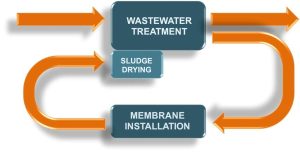
As part of the 2019-2022 project 'Towards a circular economy – technologies for the recovery of water and raw materials from treated wastewater’, the possibility of partially 'closing the life cycle’ of water has been investigated. Appropriate treatment of the treated wastewater stream allows it to be used locally for cooling in the sludge drying process. The treated effluent stream contains a number of substances (i.e. magnesium, organic suspended solids) that prevent it from being used in cooling systems without problems. Using membrane separation, (e.g. nano-filtration or reverse osmosis), contaminants can be removed and used in other processes.

The benefits of the potential implementation of integrated technology for the management of water and raw materials from treated wastewater are multidimensional, ranging from economic to environmental to operational. The environmental costs associated with the discharge of treated wastewater and the capture of raw water are reduced. Our recipient of treated wastewater – the Oder – would thus be less burdened. The use of water with a sufficient degree of purity in the cooling system greatly improves its operation, and substances removed from this water do not become ordinary waste. Their importance is increasing and the potential is being maximised for, among other things, intensified wastewater treatment and the production of natural mineral fertilisers.


Project value: PLN 2,880,375.00

Project funding: PLN 2,342,775.00

Project "Applying the Water Footprint approach to monitor, evaluate and improve urban water management (URBAN_WFTP)"

In the period November 2012 – November 2014 MPWiK implemented an international project called 'Introduction of Water Footprint (WFTP) approach in urban area to monitor, evaluate and improve the water use’ (URBAN_WFTP).

Universities, administrative units, NGOs and environmental companies from 5 Central European countries (Italy, Germany, Austria, Hungary, Poland) participated in the project.

Project Partners:

– University of Padua (Italy)

– Veneto Productivity Center Foundation (Italy)

– Vicenza City Council (Italy)

– University of Insbruck (Austria)

– alpS Ltd. (Austria)

– Nuremberg Chamber of Commerce (Germany)

– University of Environmental and Life Sciences in Wrocław (Poland)

– MPWiK S.A. in Wrocław (Poland)

– ENEREA Észak-Alföld (Hungary)

The subject of the project was the application of a tool to monitor, evaluate and improve the management of water resources in an urban area. This tool was the  Water Footprint  – indicators of water consumption directly and indirectly by the consumer or producer. It is defined as the total volume of freshwater that is used to produce goods and services consumed by individuals or communities or produced by a company. To date, the Water Footprint has found its way to global and regional scales. The aim of the project was to verify its applicability for urban areas.

As part of the project, in three cities: Innsbruck, Vicenza, Wrocław, Municipal Coordination Points were set up to assess the effectiveness of the application of the Water Footprint, to compare the results obtained and to develop a common strategy for Central Europe, with a particular focus on water management in urban areas.

The project was co-financed by the European Regional Development Fund (ERDF) under the Central Europe Programme. The ERDF is one of the European Union’s Structural Funds, which aims to reduce disparities in the level of development of the regions belonging to the European Union. The ERDF provides, among others, support for production and infrastructure investments as well as support for small and medium-sized enterprises. The activities of the European Regional Development Fund focus on the following areas:

– local development and employment initiatives, as well as the activities of medium-sized and small businesses

– viable productive investments to create or maintain sustainable employment,

– infrastructure,

– tourism development and cultural investment,

– protecting and improving the environment,

– the development of the information society.

More information about the ERDF: https://www.europarl.europa.eu/factsheets/pl/sheet/95/el-fondo-europeo-de-desarrollo-regional-feder-


The Central Europe Programme supports cooperation between partners from eight EU countries (Austria, the Czech Republic, Germany, Poland, Slovakia, Slovenia, Hungary, Italy) and Ukraine. The main objective of the programme is to strengthen territorial cohesion, promote internal integration and improve the competitiveness of the Central European area.

The programme has a project funding budget of €231 million from the European Regional Development Fund (ERDF).

For more information on the Central Europe Programme: https://www.europasrodkowa.gov.pl/

The project 'Applying the Water Footprint Approach to Monitor, Evaluate and Improve Urban Water Management (URBAN_WFTP)’ focused on private and commercial water use and aimed to:

  • Develop a common Central European approach to assessing water use and water conservation in urban areas.
  • Applying this approach to three different urban areas in three Central European countries to test its effectiveness in these contexts.
  • Promote the dissemination of the Water Footprint approach at Central European level through the activation of technologies, procedures, practices and transfer processes.
  • Evaluate the impact of new green technologies and ecological behavior on the Water Consumption Footprint in urban areas to identify the most effective and strategic solutions for decision-makers.
  • Support for decision-makers (local authorities) in the development of urbanized areas and the development of new standards for water installations in buildings.

Total project value: EUR 1,626,291.00

MPWiK share: EUR 167,136.00 

including co-financing from the European Regional Development Fund EUR 142,066.00

Project "Optimisation of nitrogen removal - improvement of treatment effects and a step towards energy self-sufficiency at the Wrocław Wastewater Treatment Plant"

Between 2014 and 2017, MPWiK, together with Wrocław University of Science and Technology and Wrocław University of Environmental and Life Sciences, carried out a research and development project entitled: „Optimisation of nitrogen removal – improvement of treatment effects and a step towards energy self-sufficiency at the Wrocław Wastewater Treatment Plant”. It was co-financed by the National Centre for Research and Development as part of the second competition of the Applied Research Programme (http://www.ncbir.pl/programy-krajowe/program-badan-stosowanych/).

As part of this project, a WWTP Research Station was built, that uses the leachate stream from the sewage sludge sewatering. The aim of the study was to provide a comprehensive solution to the nitrogen problem at the treatment plant, i.e. to develop technological solutions to ensure an economical, stable and sufficiently low level of total nitrogen in the treated wastewater.

The constructed research station includes Sequential Biological Reactors (SBR), in which biological processes are carried out, systems for physicochemical separation and a laboratory for performing analyses during these tests. The Station’s equipment allows three important tasks to be carried out for the treatment plant:

– to investigate the possibility of cultivation nitrifying bacteria involved in nitrogen removal,

– exploring the feasibility of anammox process,

– carrying out membrane separation and ion exchange processes.

Experimental results from the WWTP Research Station were used to carry out simulation studies, in a mathematical model created for this purpose. This provided an answer to the question of which of the proposed/researched solutions is the most technologically and economically advantageous.


Aktualnie wyświetlana jest treść zastępcza z YouTube. Aby uzyskać dostęp do rzeczywistej treści, kliknij poniższy przycisk. Pamiętaj, że spowoduje to udostępnienie danych zewnętrznym operatorom.

Więcej informacji

Project value: PLN 3,582,900.00

Project funding: PLN 1,900,060

Project "Research into the effectiveness of new water treatment technologies as a step towards a change in thinking about the development of the water supply industry"

December 2014 saw the launch of a project entitled 'Research into the effectiveness of new water treatment technologies as a step towards a change in thinking about the development of the water supply industry’, successfully carried out jointly with the Wrocław University of Science and Technology.

The project was co-financed by the National Centre for Research and Development as part of the third competition of the Applied Research Programme (http://www.ncbir.pl/programy-krajowe/program-badan-stosowanych/).

As a result of the implementation, a Water Treatment Research Station was built at the 'Mokry Dwór’ Water Treatment Plant, with which the potential of modern water treatment techniques, including micro, ultra and nano-filtration, is being investigated.

Results of the project have been used to optimise treatment processes at the water production plants, thereby contributing to innovation within the Polish economy.


Aktualnie wyświetlana jest treść zastępcza z YouTube. Aby uzyskać dostęp do rzeczywistej treści, kliknij poniższy przycisk. Pamiętaj, że spowoduje to udostępnienie danych zewnętrznym operatorom.

Więcej informacji

Project value: PLN 5,865,250.00

Project funding: PLN 3,792,649.00

Project "Development of a new technology for evaporative water recovery (WOW Technology)"

The project, carried out by a consortium of MPWiK and the Wrocław University of Science and Technology, received funding from the National Centre for Research and Development under the Intelligent Development 2014-2020 measure in competition 1/1.1.1/2021 – Fast Track

The aim of the project was to develop a new technology for water purification and recovery, using the natural process of surface evaporation and condensation of water from the air. The technology is designed to allow water to be recovered with distillation mechanism with minimal energy input (around approximately half that of the best solutions available on the market).


During the project a prototype WOW unit was created and a pilot plant for high-pollution water treatment with a nominal water capacity of 1 m3/h and an air capacity of 5,000 m3/h to treat water from the Oder River. The installation was placed in a container on the premises of the Port Północ Sewage Pumping Station at Kleczkowska Street in Wrocław. Tests of the WOW technology included checking energy efficiency, water recovery efficiency and water treatment efficiency.

The project is a response to high market demand for new water treatment technologies due to the reduction in water resources as a result of the intensifying hydrological drought and the need to manage water from hitherto untapped sources, often with high levels of contamination (e.g. heavy metals, organic and mineral compounds). Traditional treatment techniques are then insufficient to provide the required water quality, while alternative technologies (e.g. membrane processes) are associated with high investment and operating costs. For this reason, it is necessary to develop a new, low-energy solution to handle contaminated raw material.

Project value: PLN 10,212,688.75

Project funding: PLN 4,046,501.53

Project "Automated biomonitoring network in surface water and sewage (ToxWatch)"

The aim of the project is to develop a device for measuring the toxicity of water and wastewater. The device will be based on respirometric measurements of test biomass. The toxicity of a given water or wastewater sample will be assessed by observing changes in the respiratory activity of specific microorganisms relative to a reference measurement.

The device will be fully automated – respirometric data will be analysed by an automatic algorithm developed from a dataset of manually collected measurements. Furthermore, once the toxicity of the base stream has been determined, the device – in its sewage network configuration – will perform measurements at a dilution corresponding to the concentration with which the base stream enters the wastewater treatment plant. The device itself will be developed using 3D printing technology, and all surfaces in contact with water or wastewater will be treated to achieve superhydrophobic properties. This modification is expected to minimise biofilm formation and facilitate the maintenance of the device’s tubing and measurement chambers.

There is currently no plant on the market that is based on the plant’s native biomass, is automatic and can be installed far from the treatment plant. The project will be implemented by a consortium of 3 entities: MPWiK in Wrocław, Wrocław University of Science and Technology and Highdense.

Project value: PLN 16,238,610.98

Project funding: PLN 12,523,207.59

SHARING OF INFORMATION FOR SCIENTIFIC PURPOSES

If you are interested in obtaining information about our company for use in a research paper/article, please refer to the Policy for the Release of MPWiK Information for Research Purposes on our website:

https://www.mpwik.wroc.pl/o-nas/centrum-nowych-technologii/udostepnianie-informacji/

ACCELERATION PROGRAMS - COOPERATION WITH start-ups

Accelerator programmes are an opportunity for MPWiK S.A. to collaborate with start-ups in the verification of innovative solutions. The area of interest for MPWiK S.A., which appears as a business partner in the accelerator programmes, includes technologies to improve business processes in the Company’s core business, i.e. water intake, treatment and supply, and wastewater collection and treatment. The Company’s area of interest also includes start-up proposals to improve the customer service and asset management process.

MPWiK S.A. shows a high concern for the environment, including water resources, and cooperation within the accelerator programmes is geared towards closed-loop economy technologies and those favouring the reduction of the water footprint.

In addition, for the improvement of business processes, big data solutions using machine learning and artificial intelligence and highly advanced geo-information systems solutions, including remote sensing technologies, as well as solutions close to the idea of Smart City, Industry 4.0, IoT, e.g. for the monitoring of water and wastewater parameters, are sought.

MPWiK S.A. cooperated for the first time in the role of technology recipient in the project entitled „Industrial Innovation Accelerator INDUSTRYLAB II” under Priority Axis II: Support for the environment and potential of enterprises to carry out R&D&I activities, Measure 2.5 Accelerator programme under Smart Growth Operational Programme 2014-2020. As part of this project, cooperation was established with three start-ups. One solution, involving an AI system to support sewer network damage recognition based on CCTV inspection footage, was recommended for full-scale implementation.

MPWiK S.A. also has experience in conducting technology verification of start-ups of foreign origin – including – in the project Poland Prize powered by Concordia Design Accelerator within the framework of the programme „Poland Prize”, Measure 2.5 Acceleration programmes, under Priority Axis II Support for the environment and potential of enterprises to conduct R&D&I Smart Growth Operational Programme 2014-2020, during which the usefulness of an innovative water treatment method was verified.

Currently, MPWiK S.A., as a technology recipient, is cooperating with several startups under Measure 2.28 Startup Booster Poland Priority II: Innovation-friendly environment of the FENG 2021-2027 Programme, in a project called „Industrial Innovation Accelerator INDUSTRYLAB III” and „Concordia Design Accelerator – We turn ideas into human profit” .

MPWiK S.A.’s cooperation with start-ups is not closed to accelerator programmes. The company also works directly with young innovative companies.


SMARTFLOW

The SmartFlow system is a development by MPWiK created in conjunction with IT companies: Microsoft and Future Processing. It is a response to the water loss problem faced by all water companies. Water losses are the difference in the volume of water injected into the network and the volume of water sold to users and consumed for the needs of the water utility.

Smartflow, as an innovative software for reducing water losses, works on the basis of sensors located on the water network that provide information on water distribution 24/7. As part of this solution, Wrocław was divided into dozens of DMA zones (District Metered Area) based on a methodology taken from the IWA (International Water Assosiation). The IT system includes nearly 100 devices that monitor the quantity and pressure of water flowing through the water supply network. This allows MPWiK staff to easily locate one of the most difficult types of water supply failure, the so-called 'hidden leak’.

Particular emphasis was placed on the analysis of minimum night flows in DMAs in order to achieve and maintain specific levels of the most important ILI (Infrastructure Leakage Index) derived from the IWA methodology.

The developed SmartFlow functionality allows for a clear visualisation of the entire urban area covered by the DMA zones. The system developed for the appropriate use of the data and its specialised presentation allows complex information to be easily analysed even by non-specialists in water network diagnostics.

More about Smartflow: https://www.smart-flow.eu/


BENCHMARKING

Izba Gospodarcza Wodociągi Polskie (IGWP)

For many years, MPWIK S.A. has been a member of the Chamber of Commerce Polish Waterworks (IGWP), an economic self-government organisation in the water and sewage industry in Poland. IGWP was established in 1992 and now associates 450 enterprises within the waterand sewage industry.

Polish water companies participate in the IGWPbenchmarking.

More about IGWP: https://www.igwp.org.pl/

European Benchmarking Co-operation (ECB)

The European Benchmarking Co-operation (EBC) is an association that conducts international benchmarking in the water and wastewater industry. The initiative was launched in 2004 by international associations, including IWA (International Water Association) and water and sewerage companies from Norway, Denmark, Sweden, Finland and the Netherlands. The ECB benchmarking includes companies from Europe, Asia, North and South America.

In Poland, four companies are taking part in the EBC benchmarking exercise – MPWiK Wrocław, Aquanet Poznań, WMK Kraków and MPWiK Warsaw.

Read more about the ECB: https://www.waterbenchmark.org/


TECHNOLOGICAL OFFER OF MPWIK and Wrocław University of Science and Technology

The Faculty of Environmental Engineering and the Faculty of Chemistry at Wrocław University of Science and Technology, together with the New Technology Centre of the Municipal Water Supply and Sewerage Company S.A. (MPWiK) in Wrocław, have been conducting joint research and development work for several years in the areas of wastewater treatment, as well as water treatment and renewal. These initiatives are part of the broader move towards a circular economy, while also addressing changes in both national and European water and wastewater legislation. The research focuses on areas such as the technical and economic optimisation of wastewater and water treatment systems, the development of environmentally safe technologies for municipal and industrial wastewater treatment, and biological nutrient removal processes. The work is carried out using modern technical and laboratory facilities by a team of highly qualified engineers and academics. One of the developed solutions is planned for full-scale implementation at the Wrocław Wastewater Treatment Plant, and further implementations are currently under negotiation. This publication presents technologically advanced solutions that have emerged from these ongoing collaborations. The proposed technologies can also be implemented within the framework of the European Funds for a Modern Economy (FENG) financial mechanisms.

Zamknij
UWAGA AWARIA

Planowana data przywrócenia dostawy wody:
Zamknij

Brak wydarzeń w tym dniu

Zwiń
Proszę wpisać poprawny adres e-mail Zgoda na przetwarzanie danych osobowych jest wymagana dla dalszego procesu
Dziękujemy

Brak wydarzeń

STRONA, NA KTÓRĄ CHCESZ PRZEJŚĆ,
BĘDZIE WYŚWIETLANA
W STANDARDOWYM WIDOKU.

Wróć

lub

Przejdź dalej

Za chwilę usuniesz pliki cookies w serwisie MPWiK. Aby zmiany zostały wprowadzone, musimy odświeżyć stronę.
Zgadzasz się?

Telefon Koperta Email
Formularz aktualizacji danych dla klientów MPWiK
Uzupełnij formularz